IIHE - Interuniversity Institute for High Energies (ULB-VUB)
The IIHE was created in 1972 at the initiative of the academic
authorities of both the Université Libre de Bruxelles and Vrije Universiteit Brussel.Its main topic of research is the physics of elementary particles.
The present research programme is based on the extensive use of the high energy particle accelerators and experimental facilities at CERN (Switzerland) and DESY (Germany) as well as on non-accelerator experiments at the South Pole.
The main goal of this experiments is the study of the strong, electromagnetic and weak interactions of the most elementary building blocks of matter. All these experiments are performed in the framework of large international collaborations and have led to important R&D activities and/or applications concerning particle detectors and computing and networking systems.
Research at the IIHE is mainly funded by Belgian national and regional agencies, in particular the Fonds National de la Recherche Scientifique (FNRS) en het Fonds voor Wetenschappelijk Onderzoek (FWO) and by both universities through their Research Councils.
IceCube/ARA
IIHE students at the South Pole
In the Antarctic Summer 2011-2012, two PhD Student from the IIHE were working at the Pole. Thomas Meures, who went down for the ARA experiment and David Heereman, working for the IceCube Observatory. Both projects are looking for Neutrinos via their interactions in the Ice. At the Inter-university Institute for High Energies (IIHE) in Brussels we are involved in a world wide effort to search for high-energy neutrinos originating from cosmic phenomena. For this we use the world's largest neutrino telescope, located at the South Pole.
IceCube
Astroparticle Physics revolves around phenomena that involve (astro)physics under the most extreme conditions.
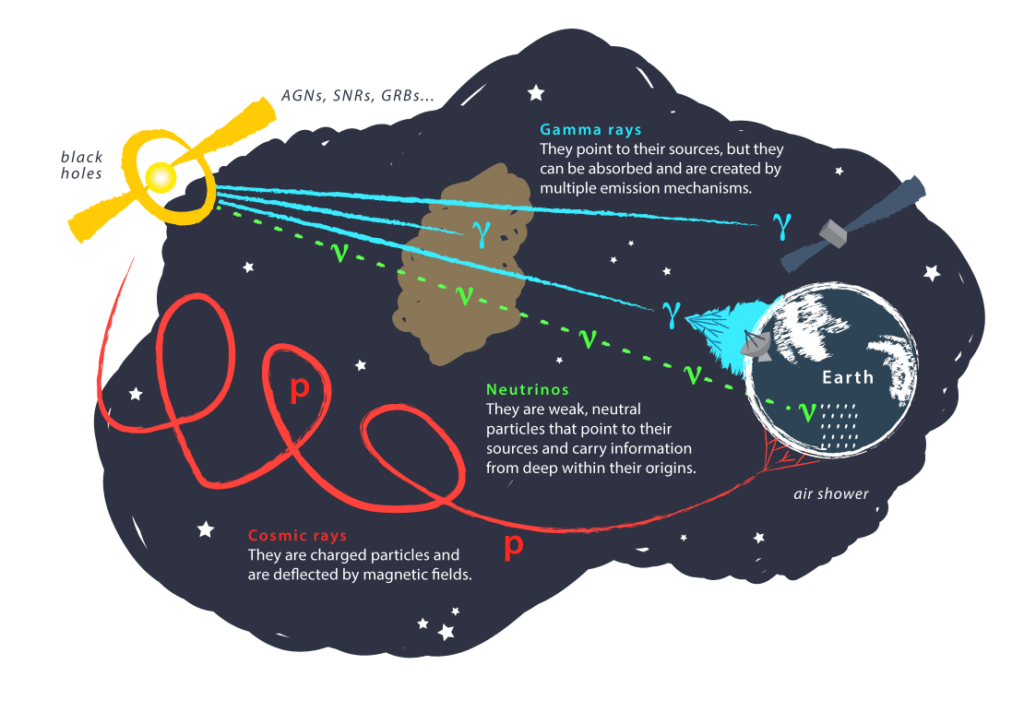
Cosmic explosions, involving black holes with masses a billion times greater than the mass of the Sun, accelerate particles to velocities close to the speed of light and display a variety of relativistic effects. The produced high-energy particles may be detected on Earth and as such can provide us insight in the physical processes underlying these cataclysmic events. Having no electrical charge and interacting only weakly with matter, neutrinos are special astronomical messengers. Only they can carry information from violent cosmological events at the edge of the observable universe directly towards the Earth. At the Inter-university Institute for High Energies (IIHE) in Brussels we are involved in a world wide effort to search for high-energy neutrinos originating from cosmic phenomena. For this we use the IceCube neutrino observatory at the South Pole, the world's largest neutrino telescope which is now completed and taking data.
CMS
The Compact Muon Solenoid forward tracker was partly built at the IIHE.
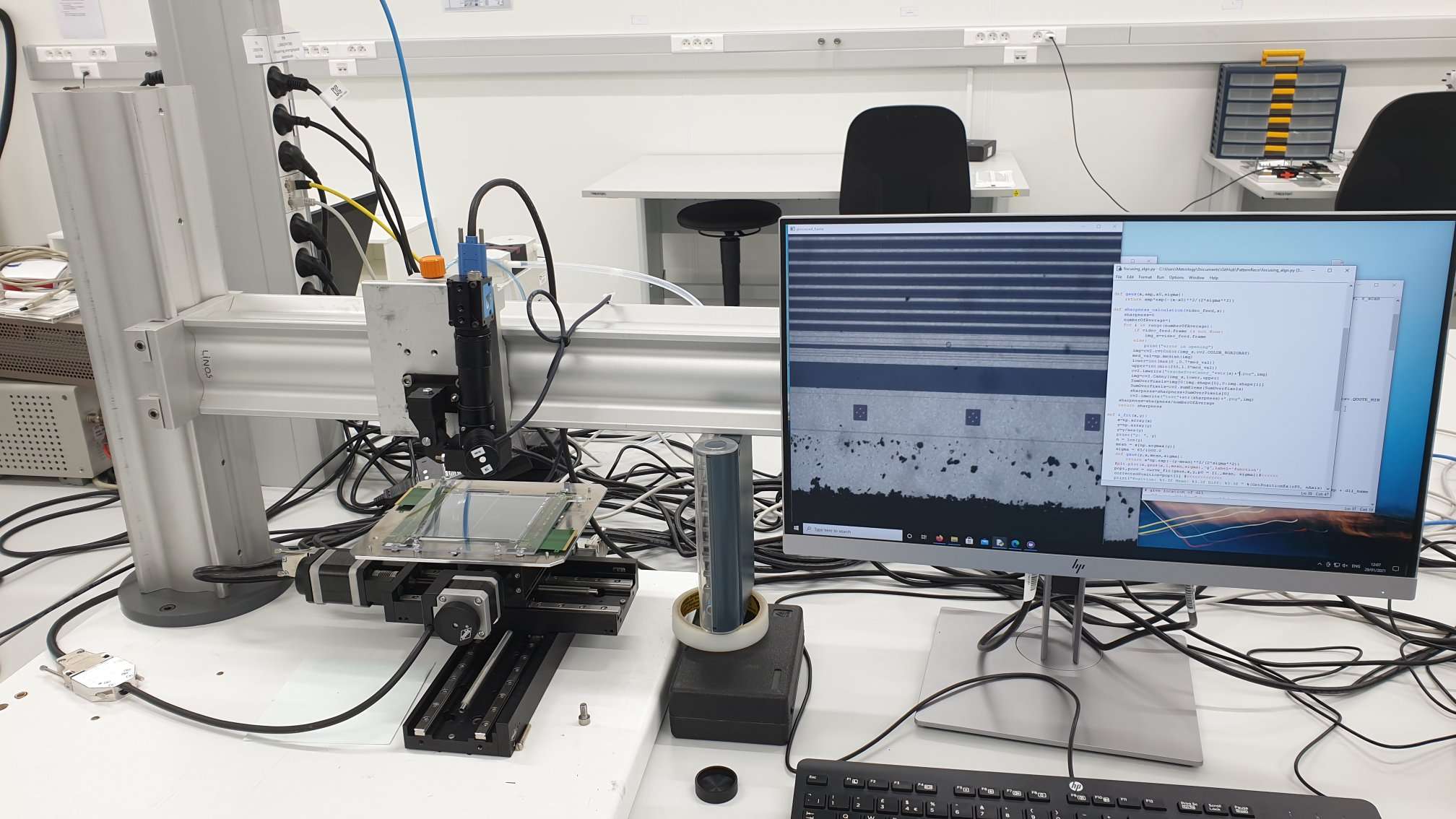
Here you see the assembly of several of the (black) support structures on which the tracker detectors were mounted. The IIHE contributed to the construction of the over 200 square meter silicon tracker, the most ambitious particle tracking detector ever built. Other contributions were made to the assembly of detector modules and the installation on the detector. Each detector element can identify the path of charged particles to a precision of up to 1/100 millimeters.
IceCube
IIHE students at the South Pole
At the Inter-university Institute for High Energies (IIHE) in Brussels we are involved in a world wide effort to search for high-energy neutrinos originating from cosmic phenomena. For this we use the IceCube neutrino observatory at the South Pole, the world's largest neutrino telescope which is now completed and taking data.Here you see a really cool phenomenon made by ice crystals that are drifting in the air at low levels and acting as prisms for the light rays passing through them. In this way, a halo around the sun is visible. In this picture, IIHE PhD Student David put his head in front of the sun and the halo becomes visible more easily.
CMS
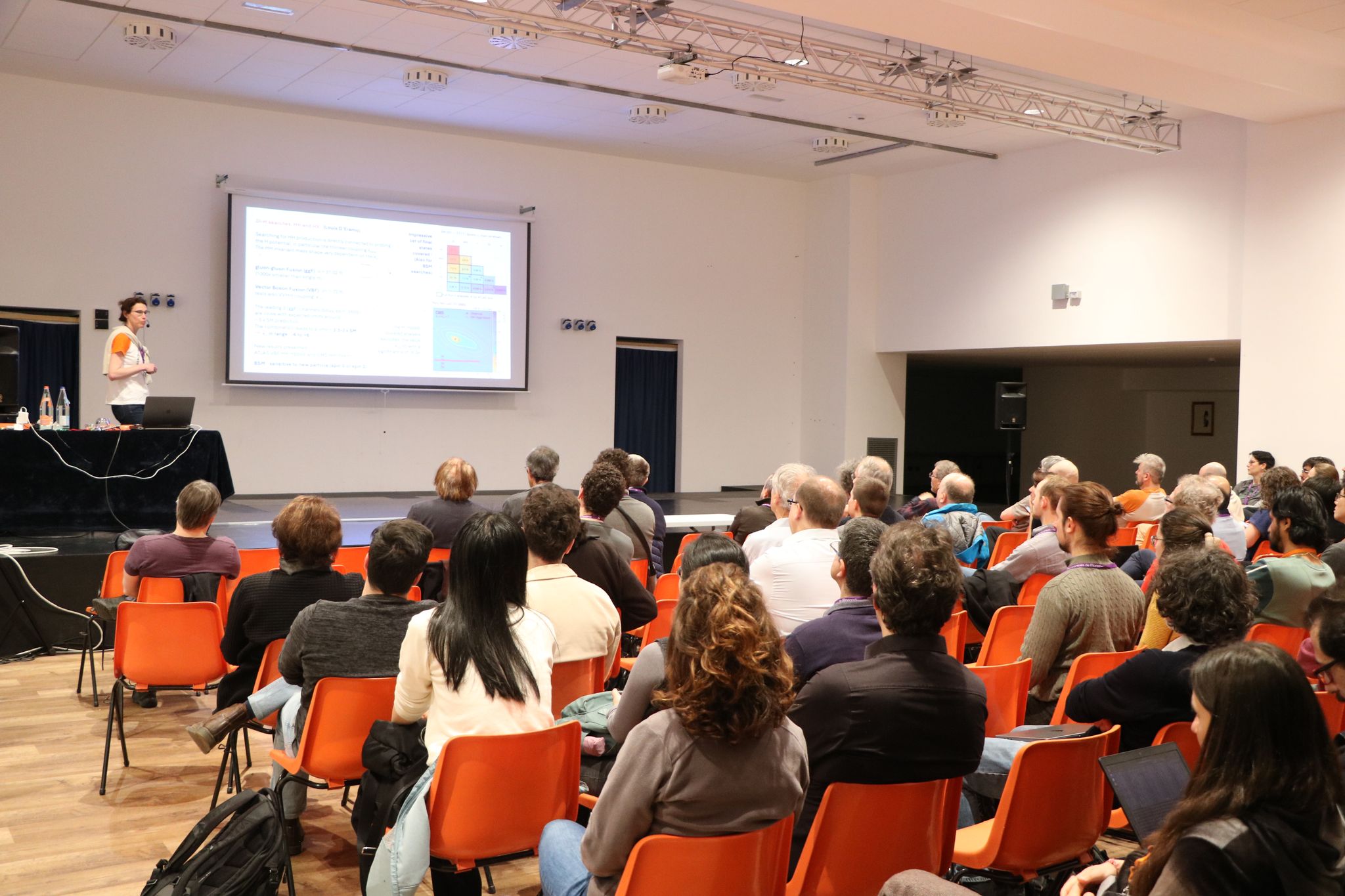
IIHE collaborators at the CMS detector at CERN
CMS is one of the two general purpose detectors for the proton-proton collider of CERN, the LHC. CMS is an international collaboration in which Belgium and in particular the IIHE has an important participation. The Brussels group has participated in the contruction of the endcap tracker detector of CMS. The Brussels teams were involved in the study of the CMS physics potential using simulations, and are now analysing the fresh LHC data at the energy of 7 TeV in the proton-proton centre of mass.
IceCube
Here you see an event recorded by IceCube in January 2008, when the detector was still in construction!
At that time, 22 strings were already taking data and 18 other strings were freshly deployed. Every colored bubble indicates the detection of one or more Cerenkov photons created by the cross of a charged particle by one of the sensors deployed in the ice. The size of the circles reflects the intensity of the signal. The color indicates the arrival time from red (early) to blue (late). These informations combined with the geometry of the detector allow first guess reconstructions of the initial track.
CMS
Shown here is a result of the 2010 LHC run at the Compact Muon Solenoid,
studying the invariant mass of electron pairs produced at the Large Hadron Collider. Shown is the data, as black dots, and the simulation predicting what we should expect according to the particle physics Standard Model (colored bands). The IIHE is actively involved in the study of this kind of collisions, in collaboration with other groups of the CMS experiment. An example of what a signature due to a new particle would look like is the (simulated) gray bump. When more data is collected in 2011 we will have enough information to also study the right side of the plot and look if there are any such particles produced at the LHC. If the grey distribution would be observed, it would be a hint of the existence of, for example, extra dimensions.
CMS
Here you see the installation of the the Compact Muon Solenoid forward tracker,
which was partly built at the IIHE. The IIHE contributed to the construction of the over 200 square meter silicon tracker, the most ambitious particle tracking detector every built. Contributions were made to the assembly of detectors and their support structures, and the assembly of the detectors on a wheel such as you can see here. The tracker was installed inside the Compact Muon Solenoid detector in December 2007.