

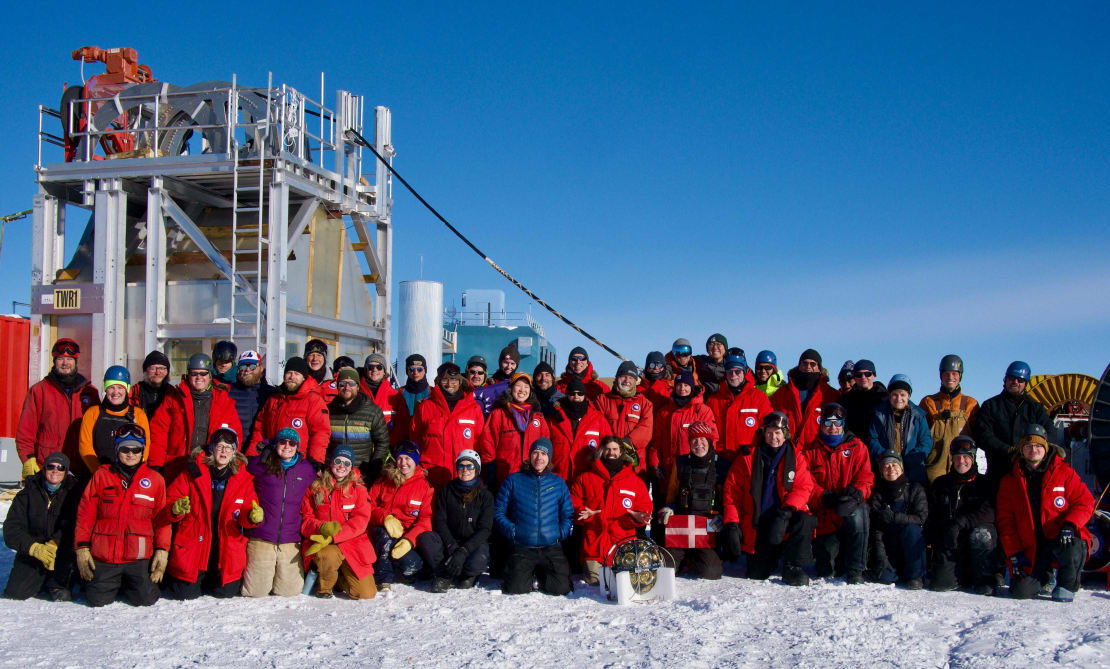
In 2019, the U.S. National Science Foundation, together with US institutional and international partners, approved funding of the IceCube Upgrade project, an improvement that would significantly push the scientific capabilities of the IceCube Neutrino Observatory. Seven years later, the IceCube Upgrade has now been successfully deployed, marking the first significant expansion of IceCube since its completion 15 years ago. “The successful deployment of the IceCube Upgrade project is a feat of U.S. engineering that demonstrates significant logistical capabilities in Antarctica,” says Marion Dierickx, NSF program director for IceCube. “This upgrade will secure the nation’s continued leadership in neutrino physics for years to come, paving the way for new cosmic discoveries.”
The Upgrade consists of five more closely spaced and more densely instrumented cables, or strings, of light sensors at the bottom center of the 86 existing strings, adding more than 600 new and enhanced light sensors and calibration instruments to the ones already embedded in the ice. A team of IceCube engineers and scientists, including Felix Schlüter from IIHE, overcame numerous challenges and the harsh working conditions at the South Pole to complete the Upgrade. During the third and final field season, a 5-megawatt hot water drill system, the largest such system in the world, was used to drill the five holes for the Upgrade. The drill team worked around the clock, with each hole taking approximately three days to complete. As soon as each hole was drilled, the installation team went to work deploying the Upgrade’s higher performing light sensors.
Now that the Upgrade is finished, commissioning will continue to be the top priority in order to verify functionality of the newly deployed devices. The Upgrade, a stepping stone to the proposed IceCube-Gen2, which, if realized, would be eight times the instrumented volume of its predecessor, will ensure that IceCube remains at the forefront of neutrino astronomy for years to come.